


"The leaders who will define the next decade aren't manging initiatives—they are orchestrating systems."
The distinction between managing initiatives and orchestrating systems matters more than it sounds. Across America’s entrepreneurship support landscape, billions of dollars flow through disconnected programs: SBDCs that can’t see CDFI data, workforce boards operating apart from capital providers, technical assistance networks with no shared outcome tracking. The result? Entrepreneurs fall through the cracks, public funds go unaccounted for, and the communities that need the most support receive the least coordinated help.
Research confirms: “Entrepreneurial ecosystems are now widely recognized as key drivers of regional innovation and economic development — but their long-term efficacy in mitigating structural inequalities or fostering inclusive growth remains deeply uncertain.” The gap between theory and practice is where entrepreneurs pay the highest price.
The Connected Economy Framework
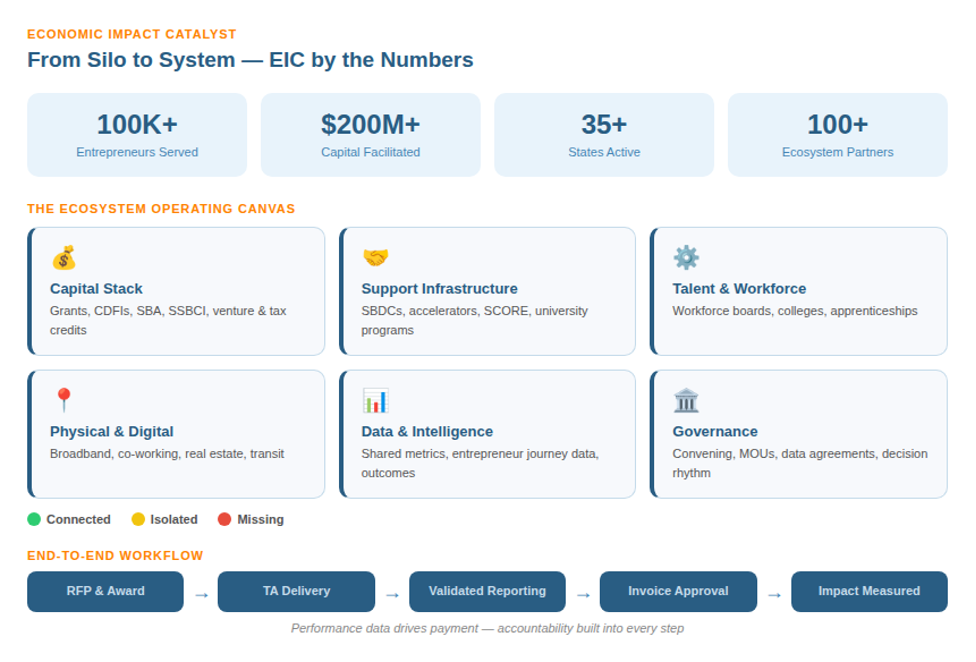
At Economic Impact Catalyst, seven years of building infrastructure across 100+ ecosystem partners in 35+ states has taught us one durable lesson: connectivity is not optional. It is the operating model.
We call it the Ecosystem Operating Canvas — six interdependent pillars that must function as a system, not a collection of programs: Capital Stack, Support Infrastructure, Talent & Workforce, Physical & Digital, Data & Intelligence, and Governance. When any pillar operates in isolation — isolated (yellow) or missing (red) on the canvas — entrepreneurs face higher friction, longer timelines, and worse outcomes.
Recent scholarship confirms: “Entrepreneurial ecosystem outcomes depend on the interdependence of input factors — the causal relationships between them, and the continuous interaction that shapes conditions for entrepreneurs in a virtuous cycle of ecosystem development.” (Hess et al., Journal of Business Venturing Insights, 2025)
Data as Infrastructure
The most underdeveloped pillar in most ecosystems isn’t capital — it’s data. Most programs still report outputs, not outcomes. They count counseling hours, not jobs created. Invoices get submitted without a verified link to what was actually delivered.
EIC’s Unified Data Reporting Model directly addresses this: audit-ready, traceable data for every dollar, end-to-end workflows from provider application to technical assistance delivery to validated reporting to invoice approval. Performance data drives payment.
America’s SBDC network facilitated more than $6.6 billion in capital and financing in a single year — but that number only matters if the data connecting those dollars to real outcomes is trustworthy and comparable across markets. Right now, it rarely is.
Data science and visual analytics across cross-agency sources can provide the framework to analyze geographic and demographic data at a granular level — enabling targeted outreach to entrepreneurs in communities that need it most. (SBA Presidential Innovation Fellows, 2021) That’s not a future capability. It’s infrastructure we’re building today.
The Leads & Referrals Mesh
Beyond reporting, connected economies need a shared intake layer. Entrepreneurs should be able to enter from any door — a CDFI, an SBDC, a chamber of commerce — and be intelligently routed to the right support, with their journey tracked across the system. EIC’s platform enforces a 48-hour first-contact standard. In practice, most ecosystems have no such standard at all.
Research shows the average SBDC client sees roughly 15 percent job growth, compared to a national average of around 2 percent — but that performance depends on advisors actually reaching the entrepreneurs who need them. Routing and referral infrastructure is what makes that happen at scale. (LivePlan/America’s SBDC, 2025)
The Three-Phase Roadmap
EIC’s Ecosystem Canvas Roadmap operationalizes system-building across three sequential phases, each building the foundation for the next:
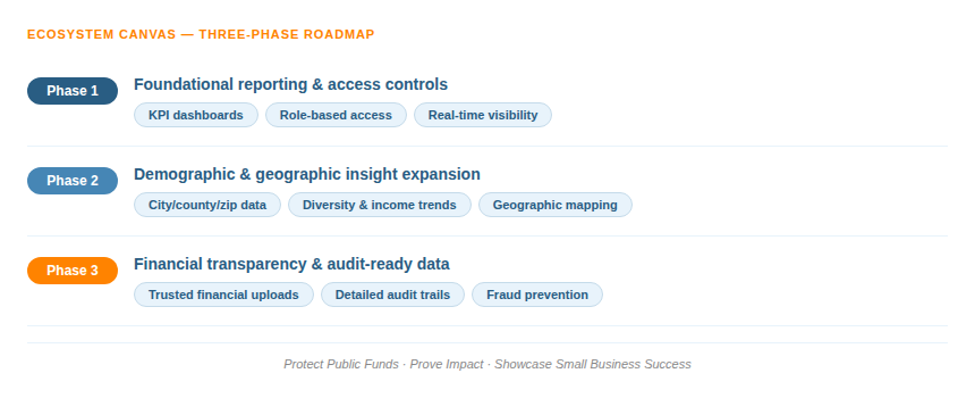
This is not a technology project. It is a governance stance. Each phase requires cross-organizational alignment, data agreements, and leadership commitment — not just software deployment.
What Next-Gen Leadership Actually Looks Like
Ecosystem leadership is not about running the best program in your network. It’s about owning the connective tissue between programs — the data agreements, the governance structures, the shared intake, the unified outcome metrics.
A unified ecosystem framework captures both the institutional foundations and the dynamic, networked nature of regional development — offering a more complete model of regional economic growth than any single-program approach ever could. (Audretsch et al., Small Business Economics, 2025)
The shift from silo to system is the defining leadership challenge of this decade. The question for every economic development leader is simple: are you managing your initiative, or are you orchestrating the system?
RESEARCH REFERENCES
- Hess, S. et al. (2025). The future of entrepreneurial ecosystems research. Journal of Business Venturing Insights.
- Hess, S. (2024). Empirical EE research: A guide to creating multilevel datasets. Journal of Business Venturing Insights.
- Audretsch, D. et al. (2025). Entrepreneurial innovation ecosystems in the US. Small Business Economics.
- America's SBDC (2025). Annual Report: SBDC Economic Impact.
- SBA Presidential Innovation Fellows (2021). Synthesizing data for equitable access to small business resources.
- Kumari, A. & Papa, A. (2025). Flying High With Entrepreneurial Ecosystems. Business Strategy and the Environment.

.jpg)